Iconographic Fusion in Caravaggio’s Amor Vincit Omnia: Cupid as a Hybrid of Ganymede and Jupiter : excerpt from seminar paper
Bar Plivazky | Admonitbar@gmail.com
Iconographic Fusion in Caravaggio’s Amor Vincit Omnia: Cupid as a Hybrid of
Ganymede and Jupiter
The Open University of Israel
Excerpt from seminar paper, The Open University of Israel, “The Classical in Art: From
Greece to the Present” (Course 10999, 2025)
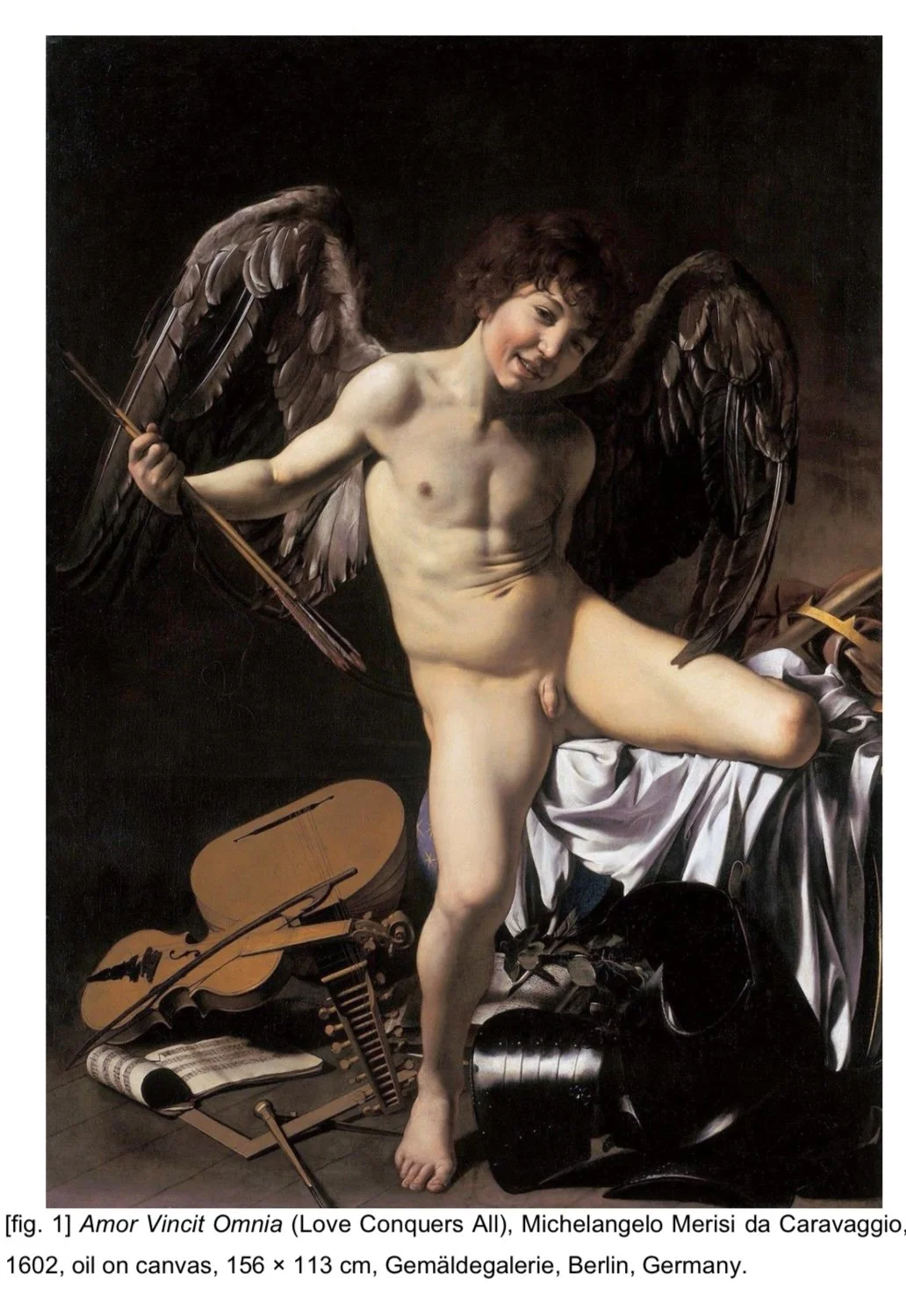
In my seminar paper, I examined the premise that the depiction of Cupid in Amor Vincit
Omnia [fig. 1], painted by Michelangelo Merisi da Caravaggio in 1602 for his patron
Vincenzo Giustiniani, is grounded in ancient Roman representations of the youth
Ganymede. Caravaggio employed a classicizing quotation but reconfigured its
meaning for his early seventeenth-century cultural world. In this work, Cupid appears
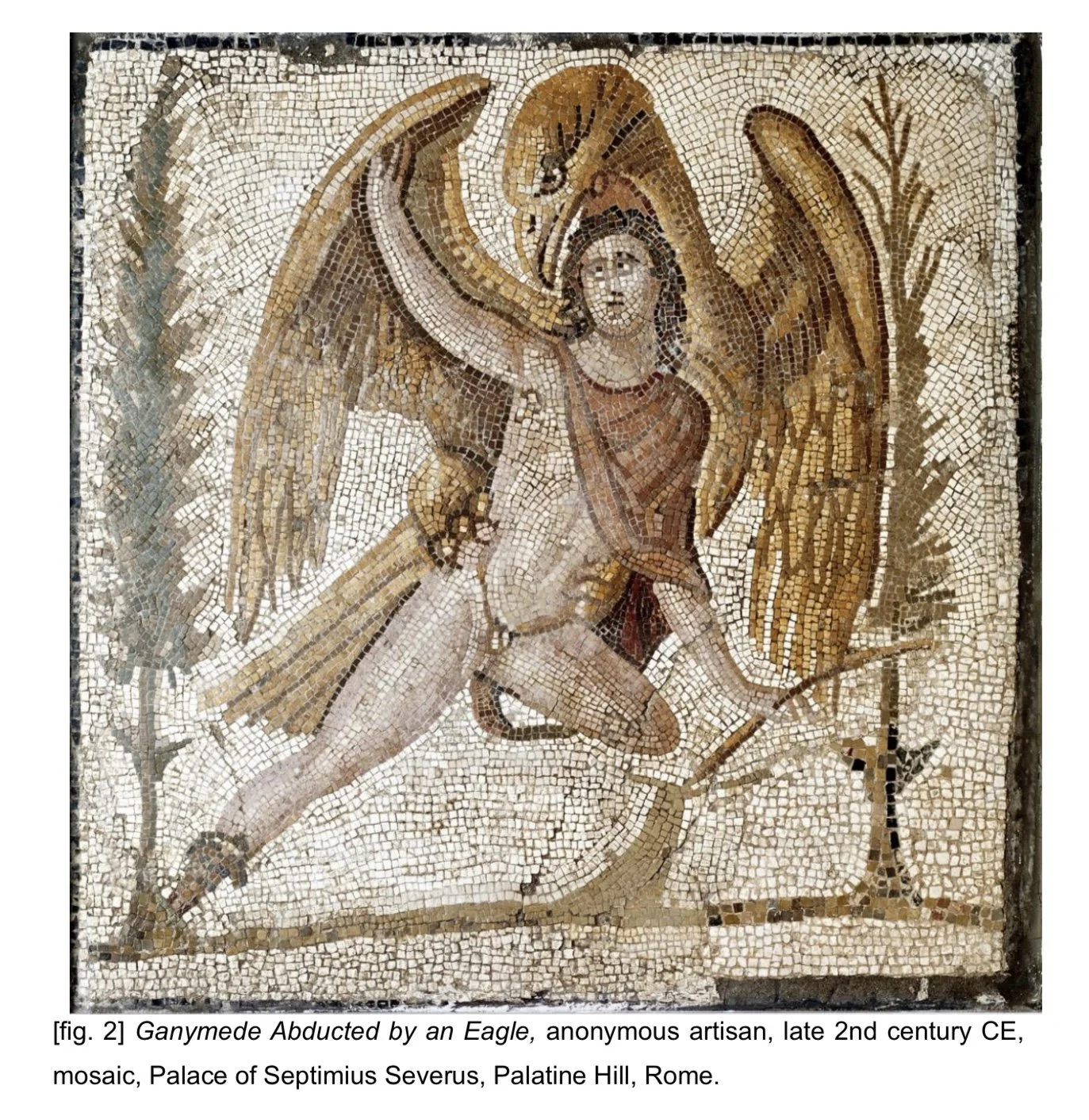
in Ganymede’s traditional pose, one leg bent while the other is extended, referencing
Ganymede’s ascent to the heavens, borne by Jupiter in the guise of an eagle [figs. 2–
3].1
To analyze the painting, I surveyed literary and visual representations of Ganymede
and Cupid in primary sources and scholarly literature. I examined the figures involved,
whether mythological or biographical, through the biographies of artists and patrons,
poetry and correspondence, legal sources, and selected works of art from ancient
Rome through the Baroque period.
Seeking to reconstruct period-appropriate modes of thought, I followed the
iconographic tradition of which Caravaggio himself would have been a student, and
considered the contemporary reception of his work. I reviewed Renaissance sexuality
and examined attitudes toward representations of Ganymede amid late Renaissance
displays. I also addressed the use of allegory as a means of concealment in
Caravaggio’s other paintings. To avoid anachronistic impositions, I emphasized
historical and sociological context, and I barely assigned interpretive weight to
contemporary gender theory.2
1 Hellmut Sichtermann, Ganymed: Mythos und Gestalt in der antiken Kunst (Berlin: de Gruyter, 1955),
66.
2 Helen Langdon, Caravaggio and Cupid: Homage and Rivalry in Rome and Florence (London,
National Gallery Publications, 1998), 18.
Ganymede in the Renaissance: between Michelangelo and Cellini
I illustrate Renaissance representations of Ganymede through two poles: Michelangelo as a
High Renaissance point of departure and Benvenuto Cellini as a later sixteenth-century pole.
Michelangelo Buonarroti (1475–1564) witnessed the shift from Reformation to
Counter-Reformation values, manifested in art by a move away from the pursuit of
Neoplatonic ideals to demands for moral purity and repression of desire.3 In The Rape
of Ganymede [fig. 4], Ganymede’s conventional pose signals Michelangelo’s classical
learning.4 He gifted this drawing to Tommaso de’ Cavalieri, whom he compared to
Ganymede in his poetry. 5 Barkan argues that Ganymede poses here as
Michelangelo’s self-allegory; a metaphor for his love, his pain, and his fear of
accusation or censorship. The image thus combines transcendent love with anxiety.6
Linking the male figure with the intellect and the divine, the work also draws on the
Neoplatonic Renaissance convention of Ganymede as an emblem of
transcendence.
7 In the sixteenth century, the sculptor Benvenuto Cellini wrote in his
autobiography that art “exalts the god you worship,” noting that “Jove used it with
Ganymede in paradise, and here upon this earth it is practiced by some of the
greatest emperors and kings.”8 Cellini’s remarks expose the double standards of his
time: on the one hand, homoerotic relations were subject to punishment; on the
other, affiliation with high social rank could offer effective protection from
prosecution.9
Although sodomy was considered a sin throughout the Middle Ages and the
Renaissance, from the mid-sixteenth century onward, same-sex acts increasingly
became a serious crime. It faced increased moral vigilance, legislative enforcement,
and artistic censorship. In its session entitled “On Sacred Images,” the Council of Trent
3 James M. Saslow, Ganymede in the Renaissance: Homosexuality in Art and Society (New Haven:
Yale University Press, 1986), 120.
4 Ibid., 38–39.
5 Ibid., 21.
6 Leonard Barkan, Transuming Passion: Ganymede and the Erotics of Humanism (Stanford, CA:
Stanford University Press, 1991), 148.
7 Saslow, Ganymede in the Renaissance, 120.
8 Benvenuto Cellini, The Autobiography of Benvenuto Cellini, trans. George Bull (London: Penguin
Classics, 1998), 324.
9 Jacqueline Murray and Nicholas Terpstra, eds., Sex, Gender and Sexuality in Renaissance Italy
(London and New York: Routledge, 2019), 32.
determined unequivocally that all manifestations of indecency in art should be avoided:
figures were not to be adorned with beauty that aroused desire, nor were any
‘anomalous’ images to be displayed in churches.10 As a result, Renaissance artists
could no longer explicitly represent erotic relations between men without risking severe
consequences.11 Thus, they increasingly used the filter of mythology.
Benvenuto Cellini carved his sensuous Ganymede in 1545, the very year of the
Council of Trent’s first convocation.12 His Ganymede, tenderly caressing the eagle and
offering it a courtship gift, is regarded as the last public Renaissance representation in
Italy to explicitly emphasize the sexual dimension of the myth.13 The limits of visual
legitimacy had been redrawn, boundaries within which Caravaggio would be
compelled to operate some fifty years later.14
In the Renaissance, Ganymede operated in both spiritual registers (Neoplatonism,
Christian alchemy) and cultural ones, and as a format for the discussion of desire and
social boundaries.
Together, these points suggest that Caravaggio may have yearned to continue the
Ganymedean tradition to encompass all these meanings and questions, including the erotic
ones. Due to censorship, he could not openly depict Ganymede, so, through classicizing
quotation, he could depict Cupid in a Ganymede-like pose to signal these at the Giustiniani
palace, hinting, for those who knew where to look, at the bond between Jupiter and
Ganymede.
10 Saslow, Ganymede in the Renaissance, 61.
11 Ibid., 47.
12 Ibid., 198.
13 Ibid., 198.
14 Ibid., 201.
Homoerotic Reading in Caravaggio’s Oeuvre
Although no conclusive evidence survives regarding the sexual orientation of either
the patron Vincenzo Giustiniani or Caravaggio himself, the bold and suggestive
sexuality of Caravaggio’s imagery, combined with its striking naturalism, has led
scholars to argue that his work projects his own sensitivities and lived experience onto
the pictorial field.15
Unlike many Renaissance artists, Caravaggio painted living bodies rather than
idealized models; his naturalism, shaped by the antique, produces a remarkably direct
homoerotic gaze that contemporaries noticed and criticized.16
The Church’s rejection of The Inspiration of Saint Matthew shows their concern about
these aspects and supports the argument for the presence of sexual themes in
Caravaggio’s paintings. This experience may have taught him to be more careful in
hiding his messages.17
Caravaggio’s art transcends the boundaries of Counter-Reformation religious painting
and offers his personal response to the mysteries of Christianity. In his public
commissions, he negotiates the integration of intellectual, critical, and personal
perspectives with the demands imposed by the Church. At times, he incorporates self-
portraiture. This fact, among others, accentuates the autobiographical connection
between his work and the experiences of his life.18
Saint Francis in Ecstasy, for example, gestures toward a Neoplatonic homoerotic
connotation. The two men occupy a pose reserved in other paintings for heterosexual
relationships, such as Venus and Adonis. Their naturalism presents corporeality
sharply illuminated and clothed in attire that is overly erotic for a religious image. The
painting includes a partially nude angel. They appear less as narrators of a Christian
15 James M. Saslow, Pictures and Passions: A History of Homosexuality in the Visual Arts (New York:
Viking, 1999), 117.
16 Barkan, Transuming Passion, 91.
17 John T. Spike, ״Saint Matthew and the Angel,״ in Caravaggio, ed. Christopher Lyon (New York and
London: Abbeville Press, 2001), 119.
18 Langdon, Caravaggio: A Life, 218.
story and more as the figures of one man supported in the arms of another within an
intimate physical encounter.
Alongside works such as this one, Amor Vincit Omnia suggests that Caravaggio
operated within an “open homosexual subculture in Rome: sophisticated, self-
confident, and wealthy enough to realize its desires and to develop its own codes and
irony.”20 His work thus articulates a dual visual language, faithful to ecclesiastical
frameworks yet subversive of them. In this language, myth and the classical ideal
function as a veil that enables the expression of non-traditional and personal desire,
either of the patron or artist, defiantly testing the limits of the period.21
19 Ibid., 123.
20 Ibid., 217.
21 Ibid., 218.
Caravaggio and the Antique
In his Lives of the Artists, Baglione recounts an episode in which Caravaggio was
advised to use classical sculptures as models.22 Caravaggio dismissed this advice by
simply gesturing toward a group of bystanders, implying that they would serve as his
models instead. Upon examination of his paintings, it becomes clear that Baglione's
story should not be taken literally. Caravaggio did not rely solely on what he saw in
everyday life; he also drew on ideas from ancient art.23 Caravaggio found much of his
inspiration in the ancient artworks around him in the homes of the Giustiniani and Del
Monte families. Living among their collections, he thought of their classical works in
relation to his own naturalistic style.24
As the public representation of homoeroticism became increasingly restricted, a
private sphere of expression emerged in which artists and patrons alike could
articulate desire while continuing to employ a restrained iconographic code, one
deeply informed by classicism. 25 Caravaggio and his contemporaries employed
quotations from the classical tradition, alla’antica; Greco-Roman art and texts served
to legitimize the aspiration to exalt images of male beauty and eros. Caravaggio
staged his models in tableaux vivants directly derived from Roman sculpture, which at
the time was mistakenly attributed to the great Greek masters.26
In his Ragazzi paintings, young boys are illustrated with garments slipping from their
bodies, exposing flesh as they extend wine or fruit toward the viewer, thereby offering
themselves.27 Some of these figures are likely self-portraits of the artist in his youth,
while others depict entertainers and young servants drawn from the circles of his
patrons. These figures push classical justification to its limits. The androgynous
Musicians [fig. 5] barely maintain the appearance of mythological allegory and more
closely resemble a genre scene depicting half-nude youths, while the figure at the
back right is possibly another self-portrait.28 Here, the mythological serves as a veil for
the depiction of inhabitants of the demi-monde who sold their services to the
aristocracy. Scholars have suggested that such figures were perceived as members
of a semi-clandestine male brotherhood of literary accademie, linked to carnival
22 Avigdor W. G. Poseq, “Caravaggio and the Antique,” Artibus et Historiae 11, no. 21 (1990): 147.
23 Ibid., 148.
24 Langdon, Caravaggio: A Life, 215.
25 Saslow, Pictures and Passions, 116.
26 Langdon, Caravaggio: A Life, 163.
27 Aaron H. De Groft, Caravaggio: Still Life with Fruit on a Stone Ledge (London: Giles, 2006), 67.
28 Saslow, Pictures and Passions, 116.
settings in which men dressed as peasants, sometimes role-played as women, and
composed carival poetry.29 Caravaggio and intellectuals within his circle wrote and
recited such poems within male academies and at carnivals influenced by Roman
festivals. Within these academies, a close affinity emerged between the imitation of
classical paganism and the performance of practices considered morally deviant. As
evidence of this, many members of these circles were accused of sodomy and of
engaging with the “blasphemous and coarse aspects of the classical world.”30
Some of Caravaggio’s paintings were perceived by contemporaries as so ambiguous
that even their identification as religious subjects was not entirely possible. A case in
point is his Saint John the Baptist, which presents a youth sensually entwined with a
ram; when the Giustiniani collection was sold in 1638, the painting was identified not
as a biblical figure but as Corydon, the shepherd from Virgil’s Eclogues.
31 This mistaken identification stemmed from the youth’s classical nudity, which evokes
Greece and Virgilian pastoral tradition, as well as from the fierce naturalism that
conflicts with conventional representations of a holy figure such as John. To this day,
scholarly discussion persists over the subject matter of Caravaggio's other Ragazzi
paintings, densely populated with poses, gestures, white draperies, and musical
instruments drawn from Roman sculpture and literature.32
The absence of Ganymede from Caravaggio's series of mythological youths, despite
the pronounced homoeroticism throughout his oeuvre, raises suspicion of
substitution.33 As I have shown, Ganymede had become so closely associated with
sodomy that his representation was no longer viable for artists wishing to escape these
accusations. Instead, within a framework of classicizing quotation, the charged myth
could be replaced with safer images. Myths and figures from the Greco-Roman world
provided a legitimate iconographic framework through which sexual deviance could
be displaced from the present into a longed-for past, from lived reality into fiction, and
from a restrictive Catholic milieu into the learned gaze of select viewers, thereby
softening the transgression.34
29 De Groft, Caravaggio: Still Life with Fruit, 69.
30 Ibid., 61.
31 ״Caravaggio and the Antique״ ,Poseq, 148–147.
32 De Groft, Caravaggio: Still Life with Fruit, 54.
33 Saslow, Ganymede in the Renaissance, 162.
34 Ibid., 65.
In this context, Amor Vincit Omnia may be read as offering Cupid as a hybrid
representation of Ganymede, encoding a homoerotic reading. 35 This maneuver
reinforces the central claim of this analysis: Caravaggio’s engagement with antiquity
operates as a strategic dialogue capable of embedding Ganymede within Cupid,
thereby masking desire. The absence of Ganymede may thus paradoxically signal his
presence in disguised form, allowing the artist to continue participating in the extensive
tradition of Ganymede representations, now concealed behind the Cupid’s mask.
35 Ibid., 200.
Iconographic Analysis of Amor Vincit Omnia
Caravaggio’s Cupid appears after a long sequence of transformations in Cupid’s
representation, surveyed here from antiquity through the Renaissance and early
Baroque, and at the height of a period saturated with Cupid imagery. Yet his Cupid
stands apart from its precedents through its exceptional iconography. The subject of
the painting is Amor Vincit Omnia, a well-known Virgilian motto from the Eclogues,
frequently depicted in the late sixteenth century.36 Typically, paintings of this title
depict Cupid triumphing over Pan, the god of shepherds, while holding a burning torch.
A contemporary example presents Cupid as an infant trampling intellectual symbols.
It likely served as a partial model for Caravaggio’s composition, yet it differs decisively
in its absence of erotic charge [fig. 6].37
The painting has distinctive iconographic features: Cupid appears alone, without the
multi-figural allegorical orchestra that usually accompanies him. Moreover, unlike most
historical representations, Caravaggio’s Cupid does not wear small white wings but
rather dark, enigmatic eagle wings. He is a youth who confronts the viewer directly,
even brazenly, his posture unashamedly erotic. Reaching his hand behind his body
without an immediately legible justification, he smiles provocatively. Is he hiding
something? His mouth is open as if singing or speaking, evoking theatricality and stage
performance, a motif deeply embedded in Baroque painting. The figure is illuminated
from above, and chiaroscuro heightens the sense of realism. A feather caressing the
thigh directs the viewer’s gaze and activates the senses synaesthetically, while
beneath the bent left leg lies a disordered arrangement of white linens.38
Cupid is shown as victorious and more powerful than all earthly pursuits, a claim
reinforced allegorically by the objects scattered beneath him. As he tramples emblems
of status (crown and laurel wreath), warfare (armor), science (compass, ruler, and
books), and the arts (lute, violin, sheet music, and pen), the painting functions as a
hybrid of still life and vanitas, presenting the “traps of civilization” as subdued by love.39
Documentation of the original viewing conditions strengthens the homoerotic reading.
The painting’s placement behind a curtain, revealed only to a restricted circle of
learned male viewers, suggests that it was intended to convey multiple meanings: a
tribute to elevated classicism and the patron’s erudition, and an object charged with
erotic tension for an audience capable of decoding it.40
36 Ibid., 2.
37 Langdon, Caravaggio and Cupid, 12.
38 Langdon, Caravaggio: A Life, 213.
39 Langdon, Caravaggio and Cupid, 17.
Visual Quotation, Classicism, and Naturalism in Amor Vincit Omnia, In Light of
The Research Question
In Amor Vincit Omnia, classicism functions for Caravaggio as a studied reference and
a contemporary transformation of antiquity. He selects a mythological subject, Cupid,
anchors it in the Virgilian motto Omnia vincit Amor, and stages a living model in a pose
derived from the classical world. The torso recalls the sculpture of Cupid Stringing His
Bow, attributed to Lysippus [fig. 7], a copy of which was present in the Giustiniani
collection. In addition, he may have adopted the leg position associated with ancient
Roman representations of Ganymede, as preserved in Michelangelo’s drawing of
Ganymede in this pose, which was housed in the Del Monte collection Caravaggio
had access to.41
Moreover, classicism in the painting elevates quotation to a form of reanimation,
reviving the ancient image among the original antiquities themselves. Caravaggio’s
Cupid animates the sculpture attributed to Lysippus and in Virgil’s verse, producing a
figure of provocative physical presence. Celebrated in its own time for its “living skin,”
the painting derives its force from the tension between classical imitation and the
expression of individualized desire.42 The youth, a figure drawn from the street,
tramples the symbols of the arts, a gesture of inverted hierarchy and penetrating wit.
Classicism, for Caravaggio, is thus not stylistic stasis but method. It is the selection of
iconography and gestures from antiquity, the encoding of erotic and moral meaning in
a language legible to his humanist audience, and their transformation into an image
that fuses classical erudition with radical naturalism, grounded in his and his patrons’
mastery of textual and visual traditions and in his sustained practice of quotation.43
The two halves of Cupid’s arrows are differentiated, one of gold and the other of lead,
a detail that testifies to Caravaggio’s familiarity with classical sources in which the two
types of arrows signify amore e disamore.
44 As for Cupid’s black wings, these may have been inspired by Giulio Romano’s depiction of Cupid with dark eagle wings [fig.
40 Saslow, Pictures and Passions, 117.
41 Barkan, Transuming Passion, 113.
42 Saslow, Pictures and Passions, 115.
43 Langdon, Caravaggio: A Life, 215 .
44 Ibid., 215 .
8], encountered either through copies or in situ on palace ceilings in the Palazzo Te in
Mantua, within plausible travel range from Caravaggio’s home town. Black wings
signify impure love, insofar as visual tradition typically associates Cupid with white
wings. By breaking this convention, Caravaggio aligns the god of love with profane
Eros, thereby warning of love’s dangerous power.
Caravaggio’s atypical Cupid pose may also allude to Michelangelo’s Victory, extending
the theme of triumph and advancing a paragone claim in which painting outdoes
sculpture.45 At the same time, Amor Vincit Omnia crystallizes early seventeenth-
century naturalism: a living model, dramatic light, and an ironic gaze that drags myth
into the present, represent a high point where divine and earthly love collide.46 The
feather grazing Cupid’s inner thigh reprises an erotics of touch associated with
Donatello, intensifying the painting’s provocative charge.47
Caravaggio’s naturalism operates in two directions. One may say that the living model
comes first, and that myth is subsequently “dressed” upon it; this creates a volatile
tension between symbol and reality.48
The argument advanced here concerns not only a fusion between Cupid and
Ganymede, but also between Ganymede and Jupiter, articulated through a hybrid,
allusive, and legible conflation. Whereas ancient Roman images commonly represent
Jupiter seizing Ganymede in a forceful yet protective gesture [fig. 2], Caravaggio may
have sought to alter the traditional image of the abduction: his eagle grasps the youth
from behind. By altering Cupid’s wings to resemble those of an eagle and by quoting
the Ganymedean leg pose, the image of Ganymede takes prominence within the figure
of Cupid. “Impure love,” embodied by the profane Cupid, collides with the figure of the
abducted youth and with Jupiter, the desiring god who carries him off to Olympus. This
collision produces an interaction between the penetrative and the penetrated. In the
hybrid creature proposed here, the penetrated figure becomes desiring, no longer
helpless or passive, but smiling toward the viewer and responding to Jupiter’s desire
with desire of his own.
Viewing Amor Vincit Omnia through the classicizing mirror of Ganymede articulates a
hybrid and transcendent eroticism that exceeds the overt eroticism of Cupid’s splayed
45 Saslow, Pictures and Passions, 117.
46 Ibid., 214.
47 Saslow, Ganymede in the Renaissance, 183.
48 Langdon, Caravaggio: A Life, 218.
legs and genitalia. Caravaggio does not depict an innocent Cupid. The age of the
model and the feather’s contact with an erogenous zone reinforce the figure as a
deliberate convergence of Ganymede and Jupiter. Love triumphs as a bodily force that
collapses hierarchies: Cupid tramples the symbols of the arts, erases the divide
between the heavenly and the earthly, and merges the quotation of a Lysippus
sculpture with a living street model. In place of classical idealization emerges a
dangerous sexuality.49 Instead of Cupid’s traditional innocence and modesty, the
figure establishes direct eye contact with the viewer, activating erotic engagement.
This archetypal fusion combines the abducted youth beloved by a god, the desiring
god whose erotic impulses perpetually entangle him, and the double-faced god of love.
Through this tripartite fusion, Caravaggio transfers the erotic charge of the abduction
myth into a new visual field, one in which Cupid’s gaze is neither fearful nor victimized,
but smiling, conscious, and inviting. Desire is no longer a heavenly event entrusted to
Jupiter, but a human and physical force.
Caravaggio’s Baroque synthesis foregrounds emotion, naturalism, and chiaroscuro:
Cupid smirks, and the image turns desire into a warning. 50 As Cooper notes,
Caravaggio’s art is iconoclastic in its insistence on lived observation.51 In Amor Vincit
Omnia, the nude is not a spiritual ideal but a self-aware invitation to the homoerotic
gaze, and his realism is psychological as well as physical.
49 Ibid., 219.
50 Ibid., 219.
51 Cooper, The Sexual Perspective, 6.
Conclusion
The discussion of the myths of Cupid and Ganymede, their iconographic traditions,
and the conditions governing the representation of sexuality in the Renaissance and
Baroque sharpens the central research question: The hypothesis that Caravaggio
conceived Amor Vincit Omnia as a classicizing quotation in which Jupiter, as the eagle,
is condensed into the figure of Cupid, enabling a veiled signal of homosexual love and
a continuation of Ganymede imagery when direct representation was no longer
possible.
This study suggests that Cupid is constructed on a recognizable Ganymedean “type,”
serving as a vehicle for the hidden transmission of homoerotic and Neoplatonic
content to a connoisseur audience within the Giustiniani palace. Caravaggio was part
of a learned humanist patronage circle embedded in courtly culture, living within
aristocratic palaces, composing carnival poetry within male academies, and deeply
informed by Neoplatonic philosophy. Thus, he would have been well acquainted with
a conceptual framework in which eros functioned as a mediating force between bodily
and spiritual beauty. This framework furnished elite circles with a cultural language
that enabled the discussion of male desire and the figure of Ganymede within an
elevated symbolic system. In further evidence of this theory, a group of northern Italian
artists active shortly before Caravaggio likewise produced homoerotic works disguised
as mythology, reflecting freer modes of life prior to the Counter-Reformation.52
The iconographic anchor for the research question lies in the affinity between Eros
and Ganymede articulated by Roscher: the archetype of the divine youth mediating
between the human and the divine realms. Like Ganymede, Cupid bears a cup, serves
as Jupiter’s companion, and signifies divine grace and eternal youth.53
At the moment when Caravaggio was active, the social and moral restrictions on
homoerotic representation generated a private erotic field populated by youthful
models appearing as Bacchus or Cupid, androgynous musicians, and images that
flirted with a new, forceful, almost secular realism.54 In Amor Vincit Omnia, Caravaggio
appears to formulate a strategy for presenting homoerotic imagery through the fusion
of alla’antica style with sharp naturalism. His strategy includes a living body, poses
52 Saslow, Ganymede in the Renaissance, 199.
53 Wilhelm H. Roscher, ed., Ausführliches Lexikon der griechischen und römischen Mythologie, vol. 1
(Leipzig: B. G. Teubner, 1884–1890), 1654–56.
54 Saslow, Pictures and Passions, 115.
recalling ancient types, scattered symbols of culture and power subdued by love, and
the presentation of a youthful figure not as abstract theology but as a concrete Roman
present.
It may therefore be proposed that Amor Vincit Omnia functions as a critical case study
to comprehend the mechanisms by which homoeroticism was encoded in the late
Renaissance and Baroque periods. Through iconographic fusion, Caravaggio
rearticulates eros as a means of constructing a visual language in which male desire
could still be expressed within an increasingly suspicious world. In this context,
Caravaggio’s contribution to the Ganymedean tradition becomes clear: the fusion of
Cupid, Ganymede, and Jupiter is more than quotation, but sublimation, in which
Ganymede becomes Cupid and Cupid “bears” Jupiter upon his back. Erotic desire is
grounded in antiquity, yet realized in an original register endowed with new meanings.
Amor Vincit Omnia reveals the triumph of classicism and eclectic naturalism over the
constraints of its time.
Bibliography
Primary sources and translations
Cellini, Benvenuto. The Autobiography of Benvenuto Cellini. Translated by George Bull. London:
Penguin Books, 1998.
Hesiod. Theogony. Hebrew trans. Shlomo Shafan. Jerusalem: Bialik Institute, 2008.
Homer. The Iliad. Hebrew trans. Shaul Tchernichovsky. Tel Aviv: Dvir, 1964.
Ovid. Metamorphoses. Hebrew trans. Shlomo Dykman. Jerusalem: Bialik Institute, 1966.
Plato. Symposium. Hebrew trans. Shaul Tchernichovsky. Project Ben-Yehuda, 1929.
Vasari, Giorgio. Lives of the Most Excellent Painters, Sculptors, and Architects. Hebrew trans.
Moshe Barasch. Jerusalem: Bialik Institute, 2021.
Secondary sources
Aurigemma, Maria Giulia. Il mondo di Vincenzo Giustiniani: Riflettere tra arte, cultura e natura Nella Roma del primo Seicento. Rome: Gangemi Editore, 2003.
Barkan, Leonard. Transuming Passion: Ganymede and the Erotics of Humanism. Stanford, CA: Stanford University Press, 1991.
Cooper, Emmanuel. The Sexual Perspective: Homosexuality and Art in the Last 100 Years in the West. London: Routledge, 1994.
De Groft, Aaron H. Caravaggio: Still Life with Fruit on a Stone Ledge. London: Giles, 2006.
Dover, K. J. Greek Homosexuality. London: Duckworth, 1978.
Hakanen, Ville. “Ganymede in the Art of Roman Campania: Ancient Roman Viewers’ Experience of
Erotic Mythological Art.” PhD diss., University of Helsinki, 2022.
Hibbard, Howard. Caravaggio. London: Thames and Hudson, 1983.
Langdon, Helen. Caravaggio: A Life. London: Chatto & Windus, 1998.
Langdon, Helen. Caravaggio and Cupid: Homage and Rivalry in Rome and Florence. London:
National Gallery Publications, 1998.
Murray, Jacqueline, and Nicholas Terpstra, eds. Sex, Gender and Sexuality in Renaissance Italy.
London and New York: Routledge, 2019.
Poseq, Avigdor W. G. “Caravaggio and the Antique.” Artibus et Historiae 11, no. 21 (1990): 147–167.
Roscher, Wilhelm Heinrich, ed. Ausführliches Lexikon der griechischen und römischen Mythologie.
Leipzig: B. G. Teubner, 1884–1937.
Saslow, James M. Ganymede in the Renaissance: Homosexuality in Art and Society. New Haven,
CT: Yale University Press, 1986.
Saslow, James M. Pictures and Passions: A History of Homosexuality in the Visual Arts. New York:
Viking, 1999.
Schütze, Sebastian. Caravaggio: The Complete Works. Cologne: Taschen, 2015.
Sichtermann, Hellmut. Ganymed: Mythos und Gestalt in der antiken Kunst. Berlin: de Gruyter, 1955.
Spike, John T. Caravaggio. New York: Abbeville Press, 2001.
[fig. 1] Amor Vincit Omnia (Love Conquers All), Michelangelo Merisi da Caravaggio,
1602, oil on canvas, 156 × 113 cm, Gemäldegalerie, Berlin, Germany.
[fig. 2] Ganymede Abducted by an Eagle, anonymous artisan, late 2nd century CE,
mosaic, Palace of Septimius Severus, Palatine Hill, Rome.
[fig. 3] The Abduction of Ganymede, anonymous artisan, 3rd century CE, mosaic,
dimensions and location unknown.
[fig. 4] The Rape of Ganymede, after Michelangelo Buonarroti, c. 1532–1533, black
chalk on brownish paper, 36.1 × 27.5 cm, Fogg Art Museum (Harvard Art Museums),
Cambridge, Massachusetts.
[fig. 5] The Musicians, Michelangelo Merisi da Caravaggio, 1597, oil on canvas, 92.1 ×
118.4 cm, The Metropolitan Museum of Art, New York.
[fig. 6] Left: Omnia Vincit Amor, unknown artist, 1600, engraving, 21.6 × 15.8 cm, private
collection.
[fig. 7] Right: Eros Stringing His Bow, attributed to Lysippus, 4th century BCE, original in
bronze (lost), Roman marble copy after a Greek original, H. 123 cm, Capitoline Museums,
Rome.
[fig. 8] Cupid, Giulio Romano, 1528, oil on stucco, ceiling of the Room of Cupid and
Psyche, Palazzo Te, Mantua, Italy.